
 English
 Español
 Pусский
 عربي
عربي How to Optimize Speed on High Speed Double Wall Paper Cup Machine for 16oz Cups
Publish Time:
Author:
Mingguo
Visit: 1631

You‘re running a double wall paper cup line. The machine‘s nameplate says 80 cups per minute. But when you switch to 16oz cups, the actual output drops to 68. The cups look fine—mostly. But every few minutes, you see an inner cup that’s shifted relative to the outer wall. Or a bottom that didn‘t seal cleanly. You speed up to chase the rated output, and the reject rate climbs.
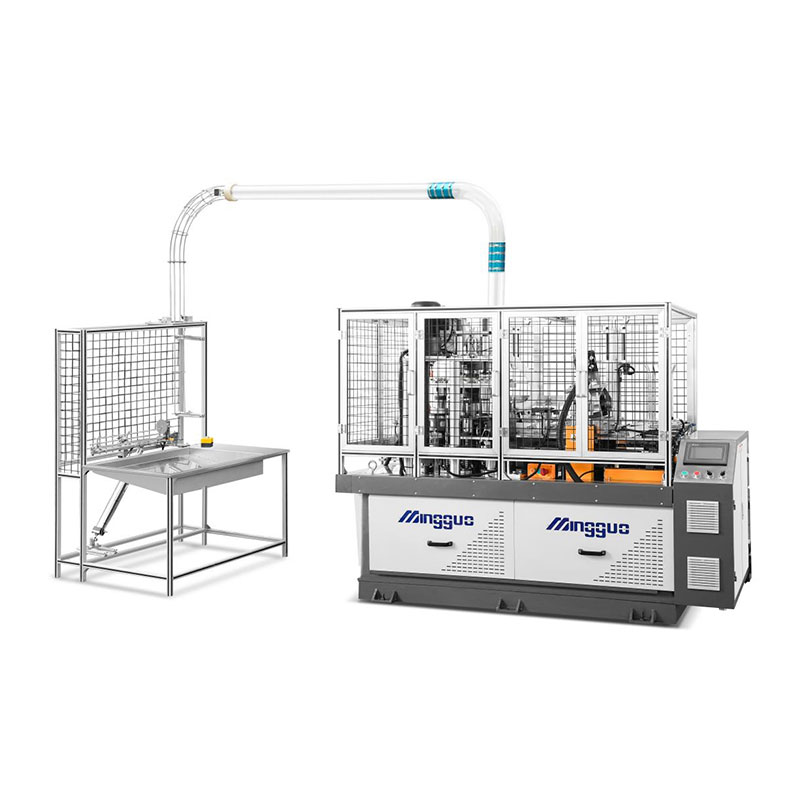
Here’s the reality: a paper cup machine running double wall 16oz cups is rarely limited by the machine‘s mechanical maximum. It‘s limited by three specific parameters that interact with each other: pre‑heating temperature, forming station synchronization, and paper web tension control. Mingguo Machinery‘s double wall paper cup machines feature an advanced automated control system, open cam design, and intermittent indexing for superior forming efficiency. But even the best hardware needs correct tuning to reach its potential. This guide walks through the three focus areas that deliver real, measurable speed gains—without turning your production floor into a reject pile.
Double wall cups are made from two separate paper blanks: an inner cup and an outer sleeve. They‘re formed separately, then joined. If the two papers have different temperatures when they meet, they shrink at different rates during cooling.
When the inner cup and outer sleeve are joined, the heat from the sealing process causes both papers to shrink slightly. If one layer is significantly warmer than the other—because it was pre‑heated more, or because it spent more time in the heating zone—the shrinkage is uneven. The outer sleeve may ride up, or the inner cup may slip down relative to the outer wall. This axial slip is the most visible symptom of inadequate pre‑heat.
In production, this shows up as cups where the outer wall is misaligned with the inner rim—a cosmetic defect that customers reject. At higher speeds, the problem gets worse because there‘s less time for heat to transfer evenly.
For most double wall paper grades used in 16oz cups (typically 200‑280gsm with PE coating), the target pre‑heat temperature is 80–100°C. The exact number depends on the paper weight and the ambient conditions in your plant. On Mingguo‘s machines, the paper pre‑heating section is integrated into the forming sequence.
The most reliable indicator is the axial position of the inner cup relative to the outer sleeve. Stop the machine and pull a sample cup. Cut it open along the seam. If the inner cup has shifted more than 1mm up or down relative to the outer wall, your pre‑heat is off. Increase the pre‑heat temperature in 5°C increments until the alignment stabilizes. If the paper shows signs of scorching or yellowing, you‘ve gone too high—back off 5°C.
Double wall cup production requires two separate forming stations: one for the inner cup, one for the outer sleeve. These stations must be precisely timed.
When the forming stations are out of sync, the outer sleeve doesn‘t seat fully onto the inner cup. The sleeve may stop short—the cup looks like the outer wall is too short. Or the inner cup may be pushed too far through the sleeve, creating a lip that extends past the outer wall. Either way, the cup fails visual inspection and often fails the seal integrity test.
The timing mismatch is subtle—often just a few degrees of cam rotation—but its effect on cup quality is dramatic.
The most reliable method for checking timing on a mechanical machine is to mark the camshaft positions for each station and measure the angular difference with a dial indicator. The two forming stations should be within ±0.5° of each other. If the difference exceeds 1°, you‘ll see visible misalignment in the finished cups.
On Mingguo‘s MG-G800 model, the open cam design and intermittent indexing system provide more consistent timing than closed‑cam designs. The open design allows easier access for timing adjustments and inspections.
On servo‑driven machines—or machines with electronic cam control—timing correction is a parameter adjustment, not a mechanical one. The machine‘s control system can shift the timing of one station relative to the other in 0.1° increments. If your machine has this capability, use it. It‘s faster, more precise, and doesn‘t require disassembly. Mingguo‘s advanced automated control system supports this level of fine‑tuning.
The paper web feeds from a large roll through tensioning rollers into the blanking station. At high speeds, the inertia of the paper roll creates tension fluctuations that cause feed errors.
When the machine accelerates to forming speed, the paper roll‘s inertia resists the acceleration. The paper between the roll and the feed rollers stretches, then snaps back. This creates a tension wave that propagates through the feed system. The result: inconsistent blank positioning, which leads to misaligned seams and poor bottom seals.
The solution is a tension‑compensating dancer arm—a pivoting roller that absorbs tension fluctuations. If your machine doesn‘t have one, adding one is a relatively simple upgrade. If it does, check that the dancer arm moves freely and isn‘t sticking.
The feed rollers that pull the paper from the roll need consistent grip. Standard steel rollers can slip on coated papers, especially at high speeds. Silicone‑coated or rubber‑coated feed rollers provide more consistent friction and reduce slippage. If you‘re running PE‑coated paper at high speed and seeing feed errors, roller material is worth checking.
A simple but often‑overlooked adjustment: make sure the paper roll shaft is perfectly parallel to the machine centerline. Even a 1‑2 degree misalignment causes the paper to track to one side, creating uneven tension across the web width. Use a spirit level on the shaft ends—it‘s a five‑second check that eliminates a common source of feed variation.
[Image: Paper web feed section showing tension dancer arm and silicone‑coated feed rollers on a double wall cup machine]
Each adjustment you make needs validation. Don‘t assume that a change that worked on one run will work on the next.
After each adjustment—pre‑heat temperature, timing correction, tension dancer adjustment—run the machine at increasing speeds in 5 cups/min increments. At each speed step, run for 10 minutes and check:
Inner/outer alignment – Cut sample cups and measure the axial position of the inner cup relative to the outer sleeve. Variation should stay within ±0.5mm.
Bottom seal strength – Perform a peel test on the bottom seal. The paper should tear before the seal separates.
Rim curl completeness – Inspect the top rim under magnification. Any gaps or incomplete curling indicates the forming speed has exceeded the machine‘s capability for that paper grade.
Stop increasing speed when any of the three quality checks fails. The highest speed that passes all three checks is your new operating speed for that paper grade and cup size. Record it in your machine log. When you switch paper suppliers or grades, repeat the test.
Below is a quick reference table for the three focus areas and their adjustment ranges:
| Focus Area | Adjustment Parameter | Typical Range | Warning Sign |
|---|---|---|---|
| Pre‑heating | Temperature | 80–100°C | Inner cup axial slip >1mm |
| Station timing | Cam angle difference | ±0.5° | Outer sleeve not seating fully |
| Web feed | Dancer arm tension | Varies by paper weight | Inconsistent blank positioning |
| Feed roller | Roller material | Silicone vs. steel | Slippage at high speed |
Speed isn‘t always the answer. There are limits you can‘t tune past.
Low‑grade paper—high recycled content, inconsistent caliper, or low tensile strength—has a maximum speed regardless of how well you tune the machine. For some paper grades, the practical limit for double wall 16oz cups is 75–85 cups/min. Pushing past that speed will create rejects regardless of machine tuning. If you‘re consistently hitting a wall at a specific speed, test a higher‑grade paper. The cost difference may be less than the cost of the rejects.
At speeds above 80 cups/min, the machine‘s response time to a fault is shorter. If a jam occurs, the operator has less time to react. Ensure all safety guards and interlocks are functional before running at high speed. The machine‘s protective covers should be intact and properly interlocked—this is not optional.
Q: Can I run 16oz double wall cups at the same speed as 12oz single wall cups?
A: No—and expecting to is a common source of frustration. Double wall cups require two forming operations instead of one, and 16oz cups have a larger diameter, which means longer forming strokes. A machine that runs 12oz single wall at 100 cups/min will typically run 16oz double wall at 75–85 cups/min—roughly 10–15% slower. Plan your production schedule accordingly, and don‘t chase the single‑wall speed on double‑wall jobs.
Q: Does lubrication affect speed?
A: Yes—and this is often overlooked. At high speeds, cam followers and bearing surfaces experience higher loads and more frequent cycling. If lubrication is insufficient, friction increases, and the machine‘s overload protection may trigger—or the machine may slow down to protect itself. Check your lubrication schedule: high‑speed double wall production may require more frequent lubrication than standard single‑wall runs. Mingguo‘s regular maintenance program includes lubrication as a standard practice.
Q: What is a realistic maximum speed for 16oz double wall cups on a well‑tuned machine?
A: For most high‑quality double wall paper cup machines—including Mingguo‘s MG series—a realistic sustained speed for 16oz double wall cups is 75–85 cups per minute. Some machines can reach 90–95 cups/min with premium paper grades and perfect tuning, but 75–85 is the practical target for consistent quality. If you‘re consistently running above 85 without rejects, you have a well‑tuned machine and a good paper supplier.
Mingguo Machinery‘s double wall paper cup machines are engineered with the three focus areas in mind. The MG‑G800 model features three turntables, an open cam design for easier maintenance and timing access, intermittent indexing for consistent station positioning, and a longitudinal axis structure for improved forming efficiency. The advanced automated control system and user‑friendly interface simplify parameter adjustments.
The paper forming sequence—paper feeding, paper fan pre‑heating, ultrasonic sealing, bottom paper pre‑heating, bottom folding, bottom knurling, top curling, and cup output—is designed for consistent, high‑speed double wall production. Mingguo offers a one‑year warranty, 24/7 remote support, and free wearing parts before shipment.
Before you make significant adjustments to your double wall line, run a baseline test at your current speed. Record the pre‑heat temperature, timing offset (if any), and tension settings. Then make one change at a time—pre‑heat first, then timing, then tension—and validate each change with the incremental speed test. The 10‑15% output gain is realistic and achievable on most well‑maintained machines.
Ready to increase output on your double wall paper cup line? Contact Mingguo Machinery for remote tuning guidance or a quote on the Double Side PE Coated Paper Cup Making Machine. Share your current machine model, target cup size (16oz or other), and current operating speed—their technical team can provide specific parameter recommendations for your production environment.
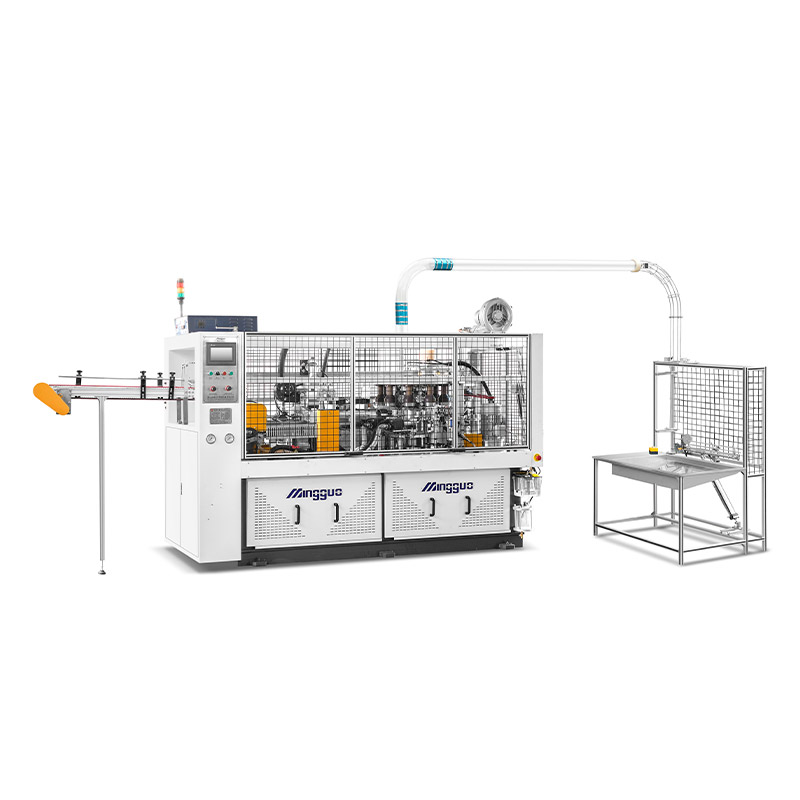
Paper cups specifications:
200 pcs/min
4-16oz(100-450mI) (mold exchangeable)
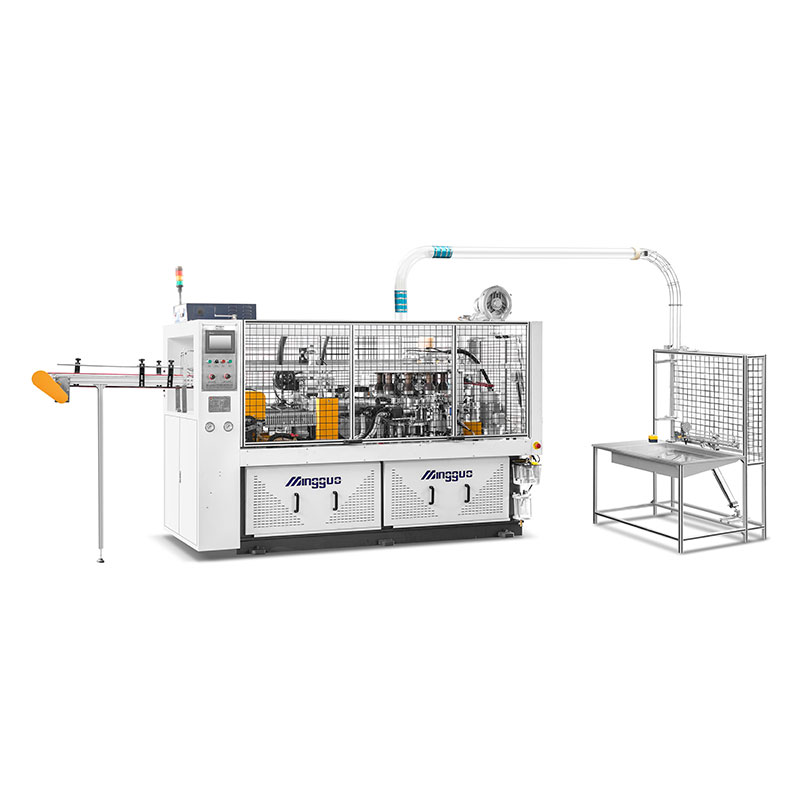
Paper cups specifications:
4-16oz (can be customized by max.26oz)
(100-450ml)(mold exchangeable)
Top:55-105mm
Height:60-135mm
Bottom:55-75mm
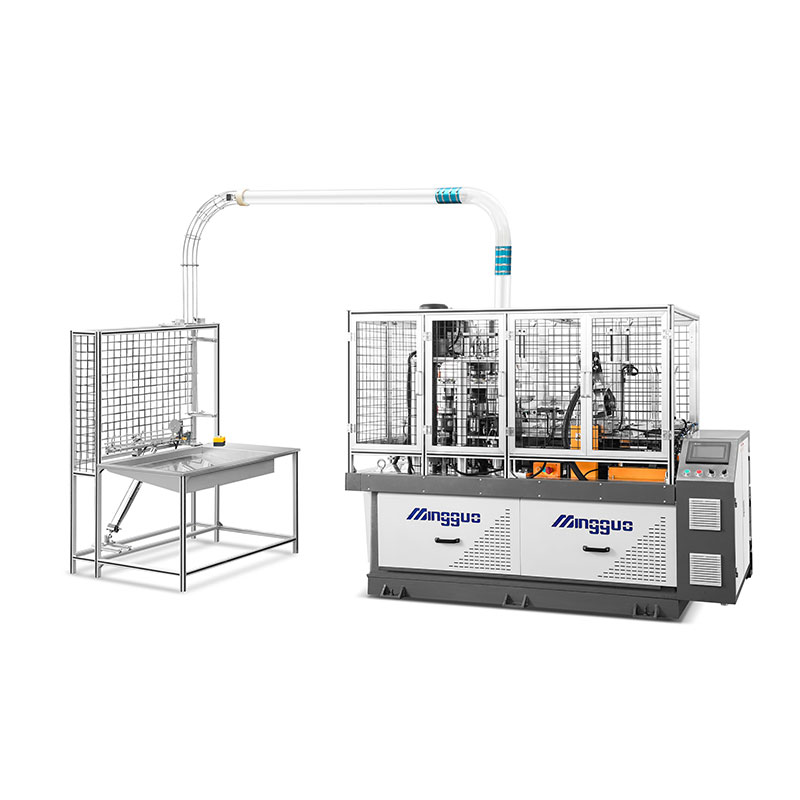
Paper cups specifications:
(100-350ml)(mold exchangeable)
Top: 55-90mm
Height: 60-110mm
Bottom: 40-65mm


