 Español
 Pусский
 عربي
عربي  Bahasa Indonesia
Does a Paper Bowl Machine Require Compressed Air?
Publish Time:
Author:
Mingguo
Visit: 219

 English

You’re planning a new paper bowl production line, and the equipment list includes a paper bowl forming machine. But one question keeps coming up: does it need compressed air?
The short answer is yes—most automatic paper bowl machines rely on compressed air for essential functions like forming punch actuation, finished bowl ejection, and pneumatic sensors. A typical Paper Bowl Machine requires 0.4 MPa (about 58 psi) with an air consumption of 0.4 m³/min.
This guide covers why paper bowl machines need compressed air, typical pressure and flow requirements, how to size a compressor, and common air supply problems to avoid. For facility planners and procurement teams, this is a practical framework for planning your air supply system.
Compressed air powers several critical functions in an automatic paper bowl forming machine. Understanding these applications helps you appreciate why a reliable air supply is non-negotiable.
The forming punch is the heart of the bowl-shaping process. Pneumatic cylinders provide the fast, controlled force needed to press the heated paper blank into the mold. Without adequate air pressure, the punch won’t deliver consistent forming pressure—and the bowls won’t hold their shape.
After the bowl is formed, it needs to be ejected from the mold. Compressed air blows the finished bowl off the mold surface, allowing the next cycle to begin. This ejection step happens rapidly—at 50-60 bowls per minute, the air system needs to respond instantly.
Pneumatic grippers handle paper feeding, ensuring precise alignment of each blank. Compressed air also blows dust off photoelectric sensors, keeping them clean and preventing false readings that could stop the line.
Not all paper bowl machines have the same air requirements. Understanding the numbers helps you size your system correctly.
Most automatic paper bowl machines operate within a pressure range of 5-7 bar (70-100 psi). A typical machine requires 0.4 MPa (about 58 psi). Running below the minimum pressure can cause incomplete forming, weak seals, and misfeeds. For deep bowls or larger diameters, higher pressure (up to 8 bar) may be needed.
Air consumption varies by machine design and the number of pneumatic components. A typical machine consumes 0.4 m³/min at the rated pressure. For a machine running at 50-60 bowls per minute, this translates to roughly 1-2 liters of air per bowl.
The compressor needs to handle peak demand—when multiple cylinders actuate simultaneously—not just the average consumption. A buffer tank (air receiver) smooths out these peaks, so the compressor doesn’t cycle on and off constantly.
Sizing the compressor correctly prevents production stoppages and extends equipment life.
For a typical machine consuming 0.4 m³/min, a compressor with a displacement of at least 0.6-0.8 m³/min (about 21-28 CFM) is recommended to provide margin for pressure drops and future expansion. An air receiver tank of 200-300 liters helps buffer peak demands.
Each additional machine adds to the total demand. For two machines, plan for at least 1.0-1.2 m³/min of compressor capacity and a larger receiver tank to handle simultaneous operation.
Compressed air contains moisture that can cause rust in pneumatic cylinders and contaminate paper bowls. Install a refrigerated air dryer to remove moisture before the air reaches the machine. For food-grade paper bowl production, an oil-free compressor and particulate filtration are strongly recommended.
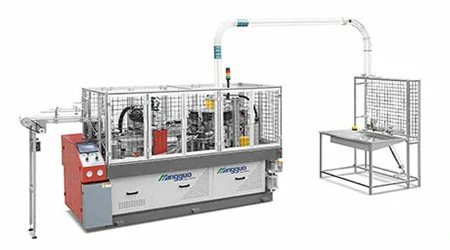
Even with the right compressor, air quality issues can disrupt production. Here’s what to watch for.
If the pressure drops below 0.4 MPa, the forming punch won’t deliver enough force. The result: incomplete bowl shapes, weak seals, and rejected products. Check for undersized compressors, clogged filters, or air leaks in the distribution system.
Oil carryover from a lubricated compressor can contaminate the paper surface, preventing proper sealing. For food-grade paper bowl production, install an oil removal filter and consider using an oil-free compressor.
Moisture in the air supply causes rust in pneumatic cylinders, leading to sluggish operation and premature failure. A refrigerated air dryer set to a dew point of +3°C to +5°C prevents condensation from reaching the machine.
Can I use a small portable compressor for a paper bowl machine?
For testing or short runs, a portable compressor might work temporarily. For continuous production, you need a stationary compressor with adequate capacity. A typical machine consumes 0.4 m³/min—a small portable unit typically delivers 0.1-0.2 m³/min, which is insufficient for sustained operation.
What happens if the air supply fails during operation?
The machine will stop at its current position and sound an alarm. Most systems require manual reset after air supply is restored. This is why a properly sized receiver tank is important—it provides a buffer of stored air that can complete the current cycle even if the compressor stops temporarily.
Do all models require the same air pressure?
No. A typical machine requires 0.4 MPa. Smaller machines may need less; larger or deeper bowl models may need up to 0.6-0.8 MPa. Always check the specific machine’s technical specification before sizing your air system.
A paper bowl forming machine engineered for reliable, high-volume production of rectangular and square paper bowls is an investment in your production capability.
MINGGUO Machinery has been specializing in paper container equipment for years, with a 20,000 m² facility and over 150 employees. The MG-GB800 Paper Bowl Forming Machine processes paper from 190-320 GSM, including single and double PE/PLA coated options, producing 50-60 bowls per minute. The machine runs on 220V/380V 50Hz 3-phase power with an average consumption of 13 kW.
Key features include an open intermittent cam system with gear rotation for high precision, Swiss Leister heaters for consistent wall and bottom bonding, paper side pre-heating, ultrasonic sealing, bowl turning robot for seamless handling, and bottom paper servo feeding. The machine supports rectangular bowl sizes from 75×65mm to 170×120mm with heights from 40-85mm.
A reliable compressed air supply is essential for the machine’s pneumatic systems—forming punch actuation, bowl ejection, and sensor cleaning all depend on clean, dry air at the right pressure. By planning your air system correctly—sizing the compressor, adding a dryer, and installing proper filtration—you’ll keep your paper bowl production line running smoothly and consistently.
Ready to plan your paper bowl production line? Reach out to MINGGUO Machinery’s team—they can provide detailed specifications, air system recommendations, and customized solutions for your production needs.
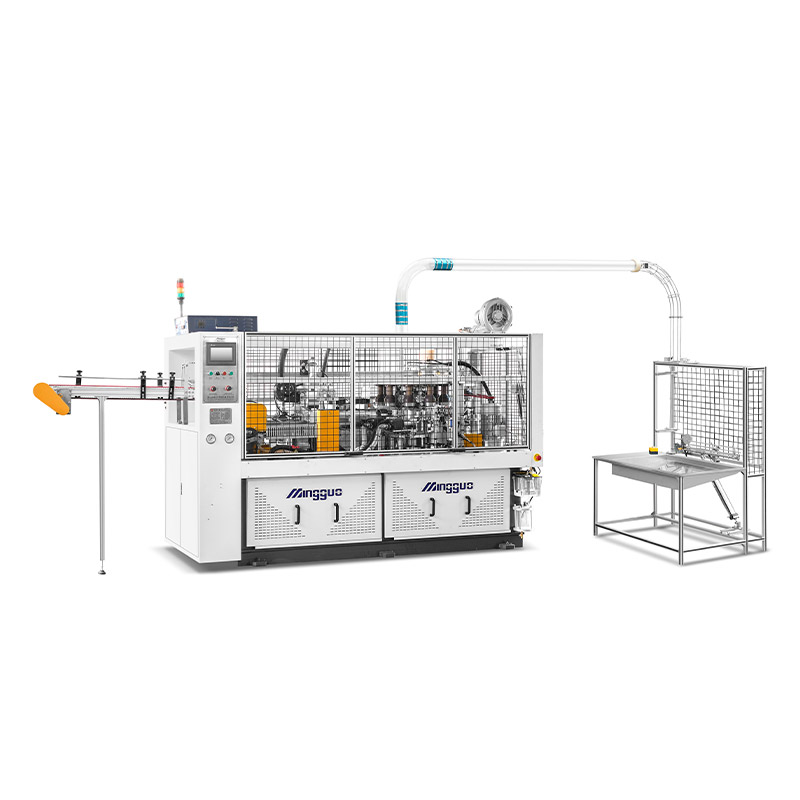
Paper cups specifications:
200 pcs/min
4-16oz(100-450mI) (mold exchangeable)
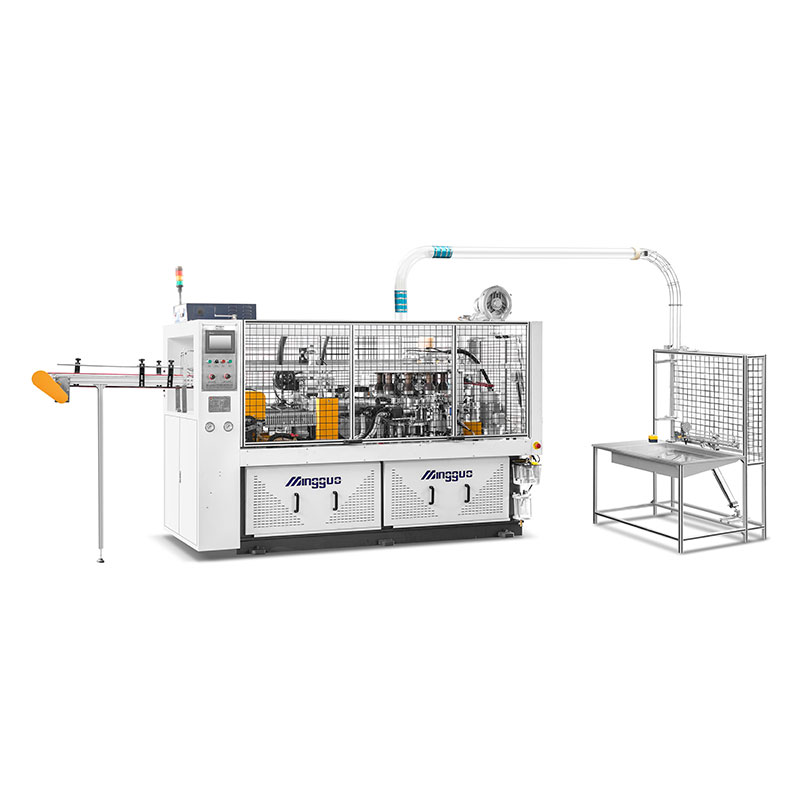
Paper cups specifications:
4-16oz (can be customized by max.26oz)
(100-450ml)(mold exchangeable)
Top:55-105mm
Height:60-135mm
Bottom:55-75mm
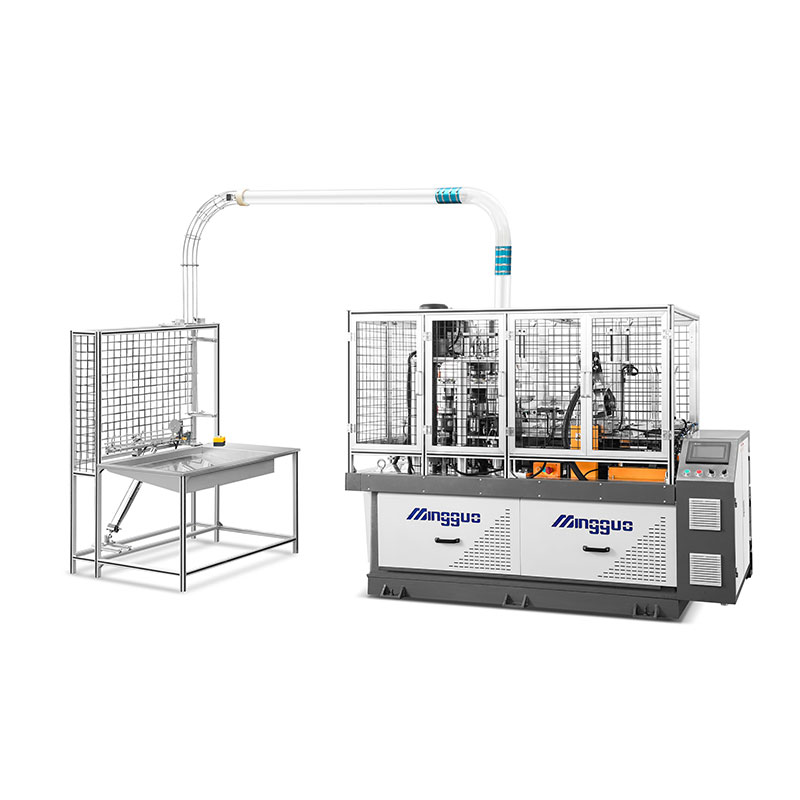
Paper cups specifications:
(100-350ml)(mold exchangeable)
Top: 55-90mm
Height: 60-110mm
Bottom: 40-65mm


