 Español
 Pусский
 عربي
عربي  Bahasa Indonesia
At 60 Cups per Minute It’s Relaxed – But at 150, a Paper Cup Machine Must Be Built Differently
Publish Time:
Author:
Mingguo
Visit: 1386

 English

At 60 cups per minute, a paper cup machine lets an operator spot a jam, tweak a temperature, or swap a paper roll without panic. At 150 cups per minute, the rhythm changes completely. A machine not built for high speed will choke – misfeeds, wrinkled rims, leaky bottoms, constant stops. This guide explains the four essential jobs every cup forming system must do, the upgrades (servo drives, ultrasonic sealing, auto shutdown) that make high speed possible, and how one manufacturer’s MG‑G800 delivers a tested 150+ cups per minute with lower waste and faster changeovers.
Every cup line, slow or fast, must execute the same four tasks. The difference is how reliably and quickly they do them.
The flat paper blank wraps around a mandrel. The overlapping edges must be sealed permanently. Two methods exist: hot air (melts the PE or PLA coating) and ultrasonic welding (high‑frequency vibrations fuse the coating). Ultrasonic is cleaner, faster, and leaves no adhesive residue – essential for high‑speed runs.
A pre‑cut paper disc drops into the tapered cup body. Heat and pressure bond it to the side wall. This seal must be perfect. A weak bottom means a leaking cup – and customer complaints. At high speed, bottom heating must be exceptionally consistent.
The top edge rolls into a smooth, rounded rim. A rough rim feels cheap and can cut lips. Curling also adds stiffness to the cup opening, making it more comfortable to drink from. High‑speed curling requires precise mechanical timing.
Finished cups release cleanly without sticking to the mandrel, then stack automatically for packing. Good ejection means less manual handling and fewer deformed cups. At 150 cups per minute, any sticking will cascade into a pileup.
Going from a standard line to a high‑speed system forces fundamental design changes. The table below summarizes the key differences.
| Aspect | Low‑speed (60/min) | High‑speed (150/min) |
|---|---|---|
| Drive system | Mechanical cams, clutches | Servo motors + inverters (Delta, ABB) |
| Side sealing | Hot air (slower, adhesive needed) | Ultrasonic (instant, no glue) |
| Bottom heating | Basic bar heater | Specialized even heaters (LEISTER) |
| Failure handling | Operator stops machine | Automatic shutdown on misfeed |
| Changeover time | Hours (wrenches, adjustments) | Minutes (servo‑driven recipes) |
The result: 2.5× more cups from the same floor space, same number of operators, and similar energy per cup.
Mechanical cams wear and drift. Servo motors hold exact position cycle after cycle. That means consistent cut lengths, straight seals, and no gradual misalignment over a shift. A line running at 150 cups/min cannot afford drift.
Hot air sealing requires preheating and dwell time. Ultrasonic welding is nearly instantaneous and works at any speed. Plus, no glue means no mess, no drying time, and no adhesive fumes. For high‑volume production, ultrasonic is the only practical choice.
Don’t trust brochure numbers. Ask these:
What’s the sustained speed over an 8‑hour shift – not just peak?
Does it use ultrasonic or hot air sealing?
What brands of drives and controls? (Delta, ABB, Siemens, or generic?)
Does it have automatic shutdown on failure?
How long to switch cup sizes? (Minutes or hours?)
Vague answers usually hide weaknesses. A transparent supplier will answer each one with data.
Mingguo Machinery (150+ employees, 20,000 m² plant) has been engineering cup lines for years. Their MG‑G800 is designed for real production, not lab tests.
Key specifications of the MG‑G800:
Sustained speed: 150+ cups/min (tested, not theoretical)
Side sealing: GREEN ultrasonic welder
Bottom heating: LEISTER heaters
Drives: Delta inverters + servo feeds
Control: PLC + HMI touchscreen
Safety: Auto shutdown on failure
Changeover: Three turntables, open cam design, intermittent indexing
Warranty: 1 year full machine
Support: 24/7 remote troubleshooting, on‑site installation
Spare parts: Free wearing parts before shipment
What those numbers mean for your floor:
150+ cups/min → 9,000 cups per hour. Two shifts → 144,000 cups per day.
Ultrasonic sealing → no glue, no warm‑up, consistent seam strength.
Auto shutdown → protects tooling; a misfeed won’t wreck the forming station.
24/7 remote support → software issues fixed without a service call.
Mingguo exports to 120 countries and provides a first‑time buyer guide (budgets, materials, ROI, design, shipping, installation). Experienced buyers can jump straight to the MG‑G800 specs.
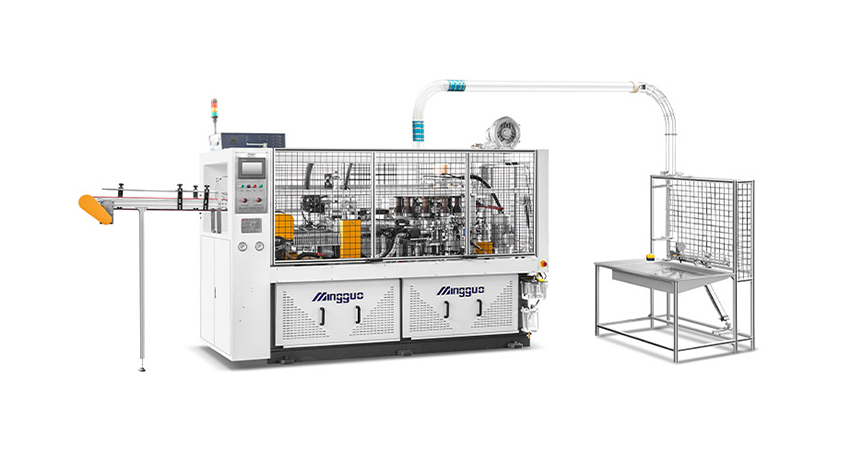
Many high‑speed machines boast 150+ cups/min but take half a day to switch from an 8oz to a 12oz cup. That kills efficiency if you run multiple sizes.
The MG‑G800’s three turntables and intermittent indexing allow size changes in minutes, not hours. Servo‑driven adjustments replace manual wrenching. A line that changes over quickly keeps your operation profitable across small batch runs.
Spec sheets love big numbers. “200 cups per minute!” looks great in a brochure. But ask the maintenance team what happens after the first hour. If that machine jams twice per shift, the real output drops below 150. A line that runs steadily at 150 cups/min with minimal stops will out‑produce a “faster” machine that keeps breaking down.
Think of it like highway traffic. A car that speeds at 200 km/h but needs a tow every 100 km won’t get you there faster than a reliable car cruising at 150 km/h. The MG‑G800 is the reliable cruiser – tested at 150+ cups/min, sustained.
Assume two 8‑hour shifts, five days a week. Factor in 10% downtime for paper roll changes, cleaning, and tooling adjustments.
Theoretical max: 150 cups/min × 60 min × 16 hours = 144,000 cups/day
Realistic output (90% uptime): 144,000 × 0.9 = 129,600 cups/day
Monthly (22 days): ≈ 2.85 million cups
That’s enough to serve a mid‑sized coffee chain or several bubble tea shops. More importantly, it’s a number you can rely on for inventory planning and customer commitments.
Instead of a standard FAQ, here are the three things buyers ask most after seeing the MG‑G800 run.
“Will it handle my biodegradable paper?”
Yes. The GREEN ultrasonic welder and LEISTER bottom heaters are compatible with both PE‑coated and PLA‑coated papers. No extra parts needed.
“How fast can we switch from a 12oz to an 8oz cup?”
With the three‑turntable design and open cam adjustment, a trained operator can complete the changeover in under 20 minutes. That’s including mold swap and recipe recall from the HMI.
“What about training – will our team struggle?”
Mingguo provides on‑site installation and training. Most operators become comfortable within two days. The touchscreen interface (PLC + HMI) is designed to be intuitive, not intimidating.
You don’t have to guess. Ask Mingguo for a live video demo running your cup size, or visit their factory. They’ll show you the stack quality, the changeover speed, and the real‑world sustained output.
A paper cup machine that delivers on its promises is worth far more than a cheap machine that never hits its rated speed. ←
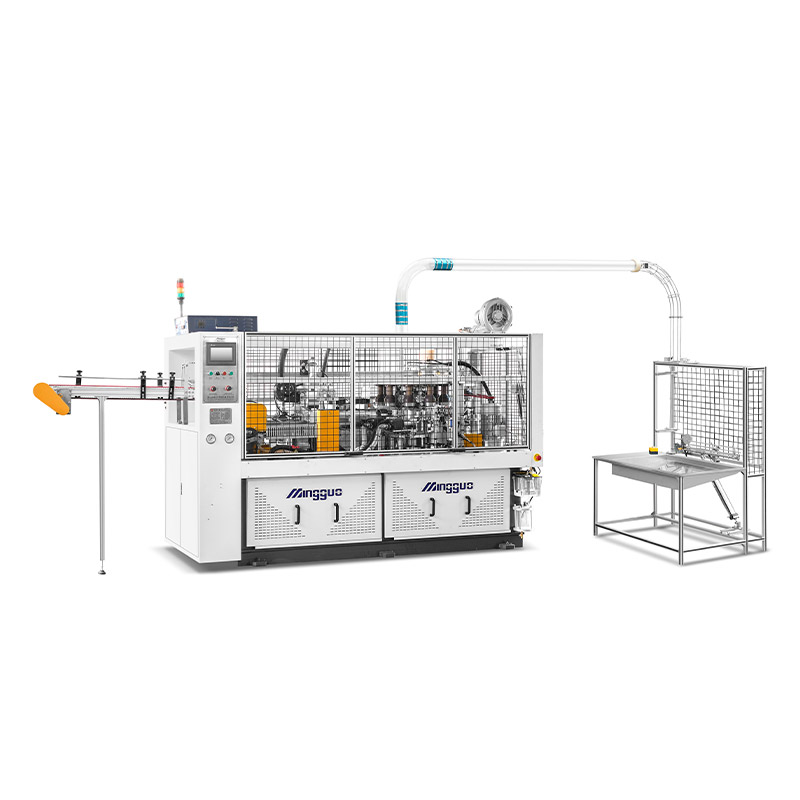
Paper cups specifications:
200 pcs/min
4-16oz(100-450mI) (mold exchangeable)
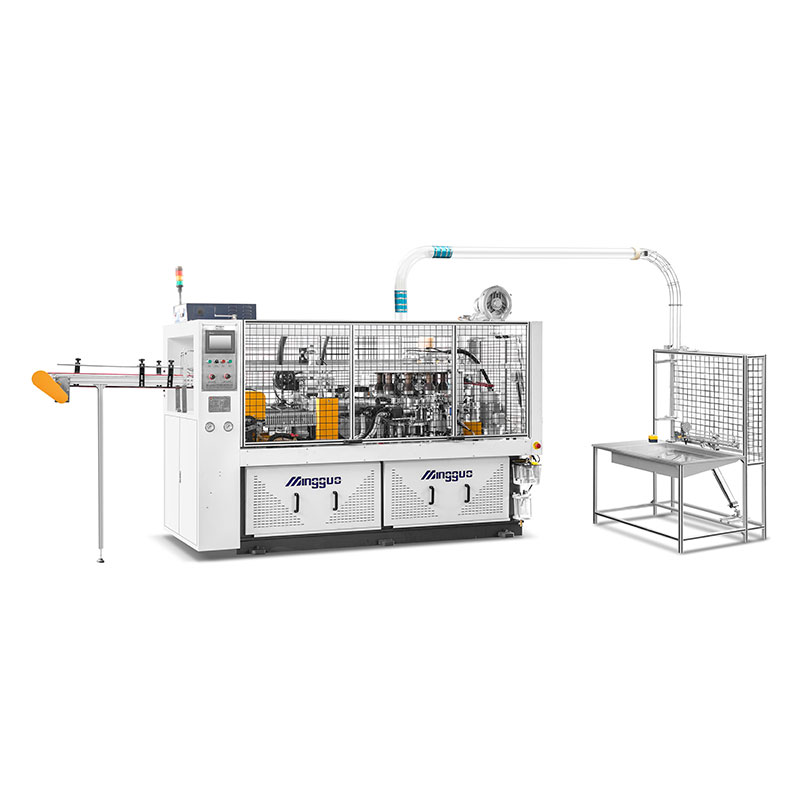
Paper cups specifications:
4-16oz (can be customized by max.26oz)
(100-450ml)(mold exchangeable)
Top:55-105mm
Height:60-135mm
Bottom:55-75mm
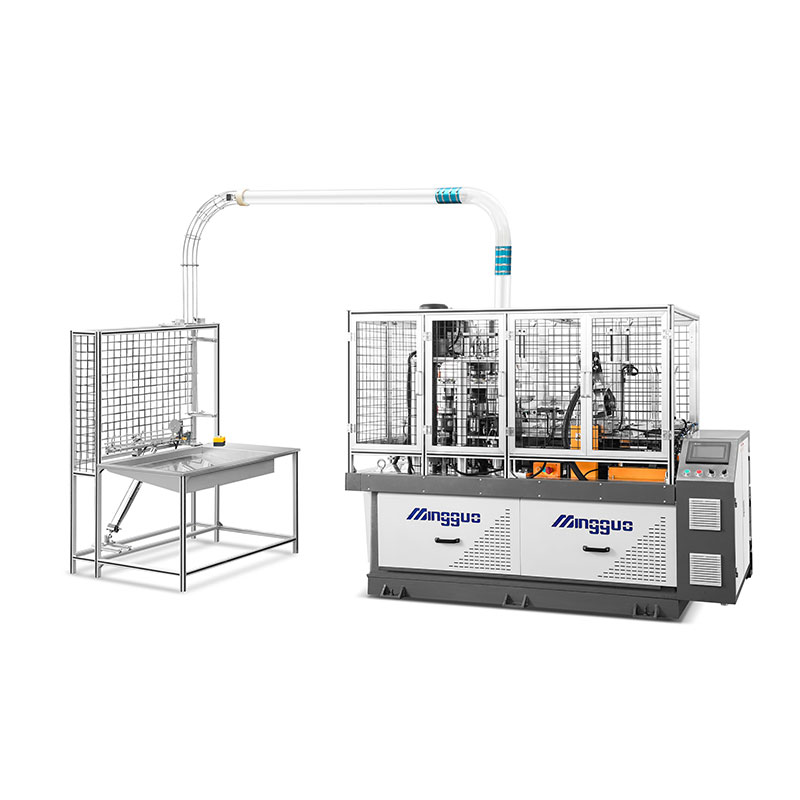
Paper cups specifications:
(100-350ml)(mold exchangeable)
Top: 55-90mm
Height: 60-110mm
Bottom: 40-65mm


