 Español
 Pусский
 عربي
عربي  Bahasa Indonesia
Have you ever wondered how a paper cup with handle machine actually works at 100 cups per minute?
Publish Time:
Author:
Mingguo
Visit: 1634

 English

You have probably seen handled paper cups in busy coffee shops and bubble tea chains. A paper cup with handle machine makes that possible by forming the cup and attaching a paper handle in one continuous flow — no separate gluing station, no manual handling. The outside feels sturdy, the handle supports the full beverage weight, and the customer walks away without needing a carrier or sleeve. This guide walks through real manufacturer specifications, so you know exactly what to look for before buying.
A standard disposable cup uses one PE‑coated paper blank. Adding a handle introduces a second component: a handle strip cut from similar paperboard. The handle is folded and sealed to the sidewall at two points — typically just below the rim and at the lower attachment. This creates a loop that can support a full 16 oz hot drink without tearing or peeling.
A paper cup with handle machine integrates handle preparation, folding, positioning and sealing into the same cycle as cup forming. Older systems required a separate machine or manual gluing, which added labor and alignment errors. Integrated machines eliminate those problems.
Based on published data for the MG‑HC600 model, here are the specifications you will actually use when comparing quotes.
| Parameter | MG‑HC600 Value | Why It Matters |
|---|---|---|
| Cup volume | 4‑16 oz (mold exchangeable) | Covers espresso to large takeaway |
| Top diameter | 55‑90 mm | Fits standard lids |
| Cup height | 60‑135 mm | Handles small and tall cups |
| Paper weight | 150‑350 GSM, single/double PE | Works with cold and hot drink stock |
| Production speed | 60‑80 cups/min (with handle) | Reliable mid‑range output |
| Power draw | 7 kW | Lower energy cost |
| Machine weight | 2,550 kg | Stable, rigid construction |
| Dimensions | 2,600×1,350×1,850 mm | Fits standard shop floors |
Some platforms now reach 100 cups per minute with an integrated handle applicator. If you run high‑volume contracts, that extra speed matters. If you change cup sizes frequently, the 60‑80 cup tier with quick‑change molds may serve you better.
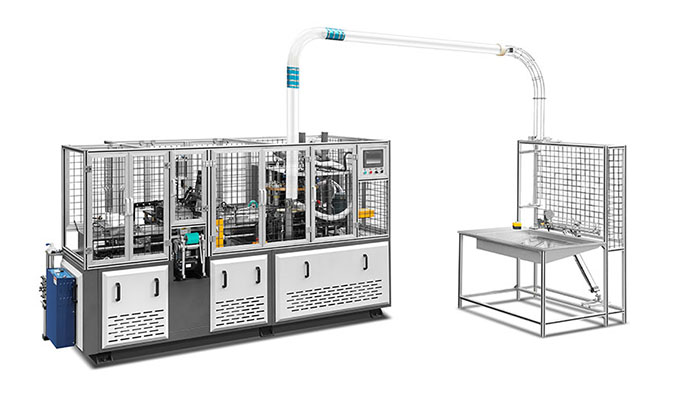
Here is what happens inside the machine during each cycle, step by step.
Paper body fed from roll, wrapped around mandrel
Side seam sealed (ultrasonic or hot air)
Handle strip cut from second paper roll
Handle folded and positioned against the cup body
Handle ends ultrasonically welded to sidewall
Bottom disc cut and heat‑sealed
Rim curled for drinking comfort
Finished cup automatically stacked
A paper cup with handle machine that integrates all eight steps eliminates the need for a separate handle‑sticking line. That saves floor space, labor, and alignment rejects.
The handle must stay attached through hot coffee, condensation and rough handling. Two main sealing methods exist.
Ultrasonic systems use high‑frequency vibration to melt the PE coating locally exactly where the handle meets the cup body. No warm‑up time. Extremely consistent seals across 150‑350 GSM. Lower energy use. Does not spread heat to the cup sidewall. The only real drawback is that ultrasonic horns cost more to replace than hot‑air nozzles. For high‑volume production (80‑100 cups/min), ultrasonic is the clear choice.
Hot‑air systems blow heated air onto the handle and cup body, melting the PE coating over a wider area. Replacement parts are cheap and widely available. However, hot air requires a 10‑20 minute warm‑up. Temperature inconsistencies create weak bonds. Heat can soften the cup sidewall near the handle, causing warping or peeling. Hot air is still found on budget machines but is less reliable for high‑speed handle attachment.
For a paper cup with handle machine running two shifts daily, ultrasonic welding is the practical recommendation.
Handled cups have moved from niche to mainstream across several segments, and each has a different reason for wanting them.
Bubble tea shops — Wide cup with handle is easier to hold while using a thick straw
Coffee chains — Handle feels more secure for walking commuters
Hot soup vendors — Soups are heavier; a handle prevents spills
Ice cream counters — Handled cup stays steady while holding a spoon
Hotels and events — Pre‑filled cups with handles are easier to carry on trays
A paper cup with handle machine that can switch between plain and handled cups gives a converter maximum flexibility. Some models allow the handle applicator to be disengaged, so the same line runs both products.
Before you sign a purchase order, get these answered in writing.
Speed claim — Is the quoted speed for plain cups or handled cups? Demand the speed with the handle applicator running.
Handle paper source — Can the machine cut handles from the same paper rolls as the cup body?
Changeover time — How long to switch from 8 oz to 16 oz and reconfigure the handle applicator?
Seal inspection — How do you verify the handle is fully bonded without destructive testing?
Spare parts — What is the lead time for ultrasonic horns and cutting dies?
A supplier that answers clearly will likely support you after the sale.
A handle line is not a plain cup line. Key training areas for your team include:
Handle‑cutting die adjustment — Set knife clearance to cut cleanly without fraying
Handle positioning accuracy — Consistent height (15‑25 mm below rim) on every cup
Ultrasonic tuning — Match frequency and pressure to the paper weight
Changeover procedure — Swap molds and handle tooling without misalignment
Machines with gear transmission instead of chain drive require less frequent tension adjustment and run quieter. Automatic lubrication extends bearing life and reduces daily maintenance.
A responsible equipment provider offers terms that protect your uptime.
One‑year full machine warranty
Remote PLC diagnostics
Spare parts shipping within days
On‑site technical support for installation and emergencies
For a two‑shift operation, same‑day remote diagnostics and next‑day parts shipping are not luxuries. A machine that sits idle for a week costs more than the spare parts you tried to save.
Every cup size and paper type is different. The paper cup with handle machine that fits a high‑volume bubble tea franchise will not fit a small coffee roaster running short custom batches.
If you run 15,000 cups per day across four sizes, invest in a mid‑speed model (60‑80 cups/min) with quick‑change molds. If you run 40,000 cups per day of just two sizes, the high‑speed platform (100 cups/min) pays for itself within a year.
For more than ten years, Mingguo Machine has supplied handle cup forming lines worldwide. Their MG‑HC600 model delivers 60‑80 cups per minute for 4‑16 oz cups on 150‑350 GSM paperboard, with ultrasonic handle sealing, automatic stacking and gear‑drive transmission. Power draw is 7 kW.
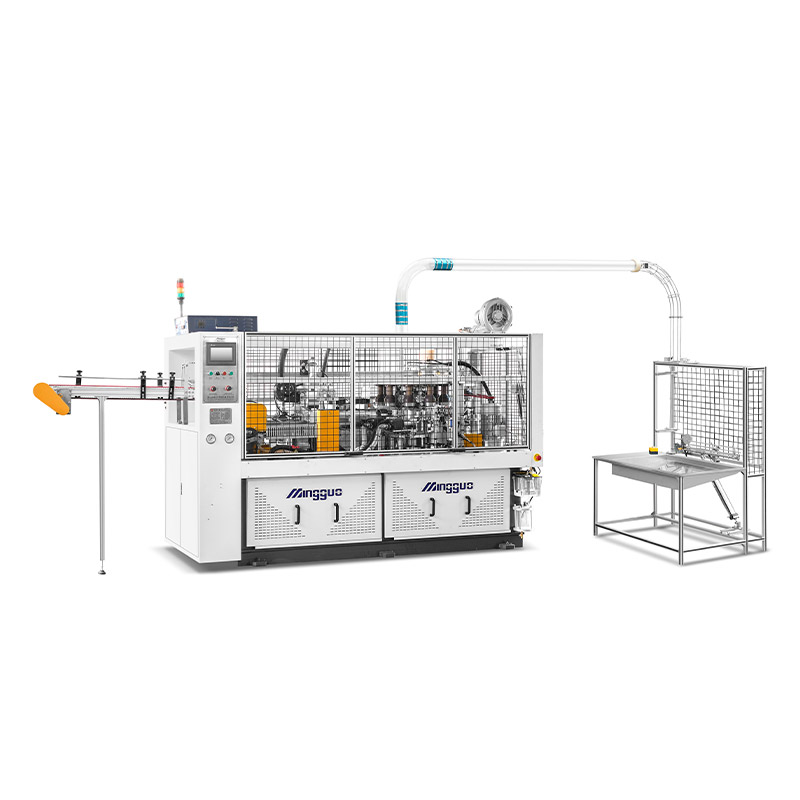
Paper cups specifications:
200 pcs/min
4-16oz(100-450mI) (mold exchangeable)
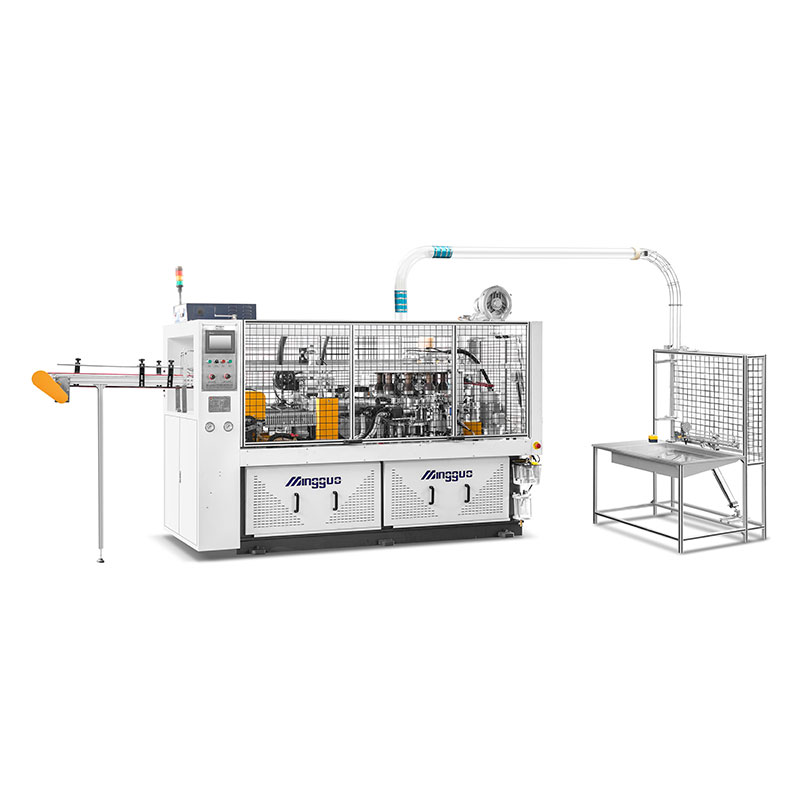
Paper cups specifications:
4-16oz (can be customized by max.26oz)
(100-450ml)(mold exchangeable)
Top:55-105mm
Height:60-135mm
Bottom:55-75mm
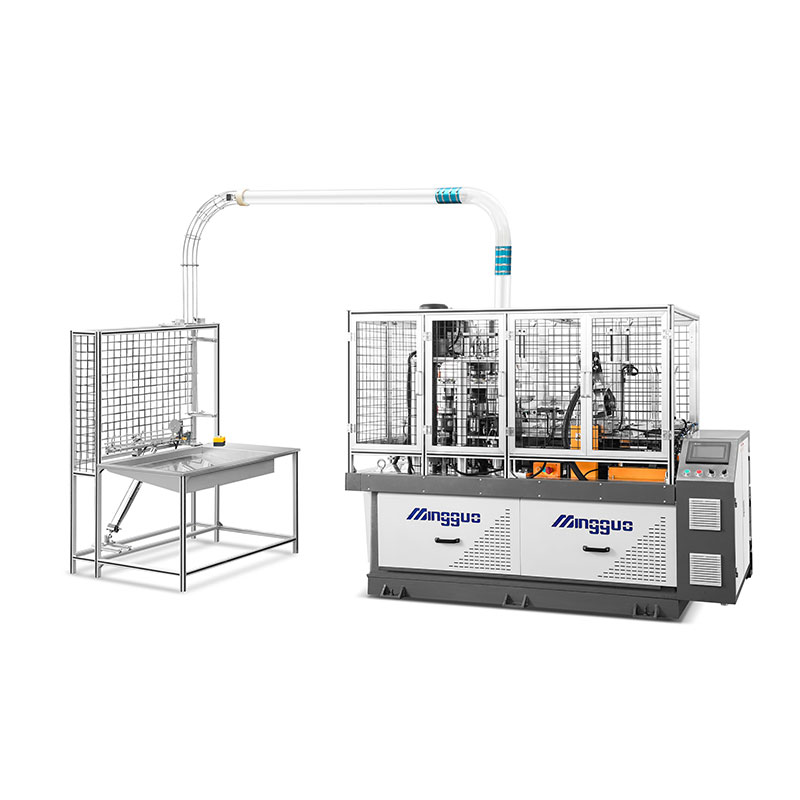
Paper cups specifications:
(100-350ml)(mold exchangeable)
Top: 55-90mm
Height: 60-110mm
Bottom: 40-65mm


