 Español
 Pусский
 عربي
عربي  Bahasa Indonesia
What Separates a Reliable double wall paper cup machine from an Ordinary Former?
Publish Time:
Author:
Mingguo
Visit: 2012

 English

You have held a double wall cup. The outside feels cool, but the coffee inside is hot. That is not magic – it is an air gap between two paper layers. A single‑wall cup transfers heat directly through the paper. A double‑wall cup traps air, which slows heat transfer and keeps the outside comfortable to hold. But making a double‑wall cup is not as simple as putting one cup inside another. The two layers must be bonded together without crumpling, and the rim must be curled cleanly.
A double wall paper cup machine does exactly that. It takes two paper blanks – an inner sleeve and an outer sleeve – forms them simultaneously, bonds them, and produces a finished cup that feels premium and keeps beverages hotter for longer. This guide explains the process, the specifications that matter from real manufacturer datasheets, and how to choose a system that runs reliably at high speed without daily breakdowns.
A single‑wall paper cup uses one PE‑coated paper blank formed around a mandrel. A double‑wall cup uses two blanks. The following table shows what each layer does.
| Layer | Function |
|---|---|
| Inner sleeve | Contacts the beverage; must be liquid‑tight and heat‑sealable |
| Outer sleeve | Decorative, provides insulation air gap, stays cool to the touch |
Between the two layers is a roughly 2–4 mm air gap. No foam. No plastic sleeve. Just trapped air. That air gap is what makes the cup comfortable to hold. The machine must form both sleeves, bond them at the top rim or along the side seam (depending on design), and curl the rim cleanly. A system that cannot maintain consistent gap spacing will produce cups that either feel too hot (gap too small) or are structurally weak (gap too large).
Based on published product data from manufacturers who specialize in double‑wall forming, a capable machine supports the following range:
| Parameter | Range |
|---|---|
| Cup capacity | 4 – 20 oz (molds exchangeable) |
| Top diameter | 50 – 90 mm (depending on cup size) |
| Cup height | 60 – 135 mm |
| Paperboard weight | Single‑PE: 170–320 GSM; Double‑PE: 210–350 GSM |
The machine is designed for sustained production. You will find two common speed tiers:
Standard speed: 60 – 80 cups per minute
High‑speed: 90 – 100 cups per minute
Here are the core component specifications you should verify on any quotation:
| Component | Typical Specification |
|---|---|
| Side sealing | Ultrasonic or hot air (both offered) |
| Bottom heating | Hot air or ultrasonic |
| Controls | PLC + HMI touchscreen |
| Stacking | Automatic, adjustable for different cup heights |
| Power draw | 12 – 15 kW |
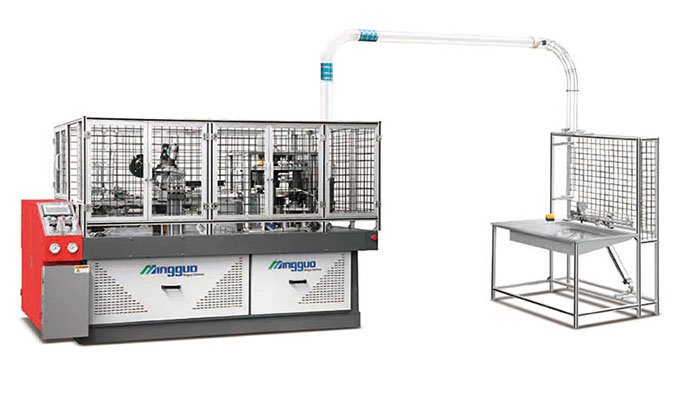
Running double‑wall cups is more complex than single‑wall. Here is why.
Precise layer alignment – The inner and outer sleeves must align perfectly. If the outer sleeve shifts during forming, the cup looks misaligned – a cosmetic reject. Better machines use mechanical guides or optical sensors to verify alignment before bonding.
Air gap consistency – The gap is created by the diameter difference between inner and outer sleeves. The forming mandrel must hold precise tolerances. A worn mandrel produces cups with uneven gaps – some spots touch (no insulation), others are too wide (weak structure).
Bonding without crushing the gap – The two layers must be bonded at the top rim or along the side seam. Too little pressure and the layers separate. Too much pressure and the air gap collapses. Ultrasonic welding is preferred because it bonds cleanly without crushing the gap.
A double wall paper cup machine engineered specifically for double‑wall production will have tighter tolerance controls than a standard cup line that has been retrofitted. (主词第2次出现)
Here is how the two production types stack up in daily operation.
| Feature | Single Wall | Double Wall |
|---|---|---|
| Material consumption | 1 blank per cup | 2 blanks per cup |
| Production speed | 100–150 cups/min | 60–100 cups/min |
| Heat insulation | Poor (requires sleeve) | Excellent (no sleeve needed) |
| Printing area | Single surface | Two surfaces (inner may be plain) |
| Cost per cup | Lower | Higher (offset by premium pricing) |
The higher material cost of double‑wall cups is offset by customer preference and operational savings. Coffee shops charge a premium for double‑wall cups. The cooler exterior also means no cardboard sleeve is needed – that is both a cost saving and an environmental benefit.
Different segments have adopted insulated cups for specific reasons:
Coffee chains (national and local roasters): Branding on the outer sleeve, insulation without sleeve inventory
Bubble tea shops: Cold drinks also benefit – no condensation drips on hands
Hot soup and noodle vendors: Double‑wall keeps contents hot without burning fingers
Hotels and catering: Premium presentation for room service coffee and events
The demand for double‑wall cups is growing faster than single‑wall in many markets. Consumers associate the thicker feel with higher quality. A double wall paper cup machine that can switch between single and double‑wall production gives a converter maximum flexibility.
If you are buying your first insulated cup line, here is a practical checklist:
Budgets – Machine price, installation, training, spare parts. Get a complete landed cost.
Materials – Paper weight (170–350 GSM), single or double PE coating. Confirm your existing paper stock works.
ROI calculation – How many cups per shift to break even? Run the numbers with your labor and material costs.
Changeover time – How long to switch from 8 oz to 16 oz? Ask for a video demonstration.
Speed claim – Is that for double‑wall or single‑wall? Some vendors quote single‑wall speeds. Demand double‑wall figures.
A supplier who provides clear answers to these five questions is likely to support you after the sale as well.
A double wall paper cup machine is only as good as the team that runs it. Key training areas include:
Mold change – Switching between cup sizes (4 oz to 20 oz) without damaging components
Layer alignment adjustment – Ensuring inner and outer sleeves line up within 1 mm tolerance
Seal inspection – Checking that both layers are bonded correctly; a simple peel test works
Gap verification – Using a feeler gauge to check air gap consistency across the cup circumference
A machine with an open cam design and three turntables (as seen on some industrial systems) allows easier access for cleaning and adjustments. Intermittent indexing gives the operator time to inspect cups between stations.
Common operational issues and how to avoid them – Even on a well‑built line, small problems can disrupt output. Here are three frequent headaches and their fixes:
Wrinkled outer sleeves – Usually caused by uneven tension between the two paper webs. Check that both unwind brakes are set to the same value (typically 2–3 Nm for 250 GSM board).
Intermittent weak seals – Often a dirty ultrasonic horn or a worn hot‑air nozzle. Clean the horn every shift with a soft cloth; replace nozzles every 800 hours of runtime.
Stacker jams – Cups sticking together usually point to residual static or excess moisture. Install an ionizing bar before the stacker and store paperboard at 40–60% relative humidity.
Having a simple logbook for these three checks reduces downtime by roughly 30% according to production managers I’ve spoken with.
When you invest in production equipment, the after‑sale support matters as much as the machine itself. Look for:
1‑year full machine warranty (minimum)
Remote troubleshooting – Ability to connect to the PLC for diagnostics
Spare parts availability – Common wearing parts (seal bars, cutting dies, heaters) should ship within days
On‑site technical support – Available for installation and emergencies
For a production line running two shifts, that support package is not a small detail. A machine that sits idle for a week costs more than the spare parts you saved.
Realistic maintenance schedule – A double‑wall line requires:
Daily: Clean sealing surfaces, check air gap consistency on 5 cups per hour
Weekly: Lubricate cam followers and check timing belts for wear
Monthly: Inspect ultrasonic horns for cracks; calibrate temperature sensors on hot‑air units
Following this schedule adds about 30 minutes per shift but can double the life of wearing parts.
Every cup size and paper type is different. A double wall paper cup machine that delivers consistent insulation, clean appearance, and sustained speed will pay for itself in premium pricing and customer loyalty.
When you are ready to move from spec sheets to a firm quotation, you need a supplier who understands these trade‑offs and does not push the most expensive option.
For more than a decade, Mingguo Machine has supplied double‑wall cup forming lines to packaging converters worldwide. Their DW‑12S series delivers 60–80 cups per minute, while the DW‑12SA high‑speed variant reaches 90–100 cups per minute. Both cover 4–20 oz cups on 170–350 GSM paperboard with your choice of ultrasonic or hot‑air sealing. Automatic stacking is standard, and power draw stays within 12–15 kW depending on configuration.
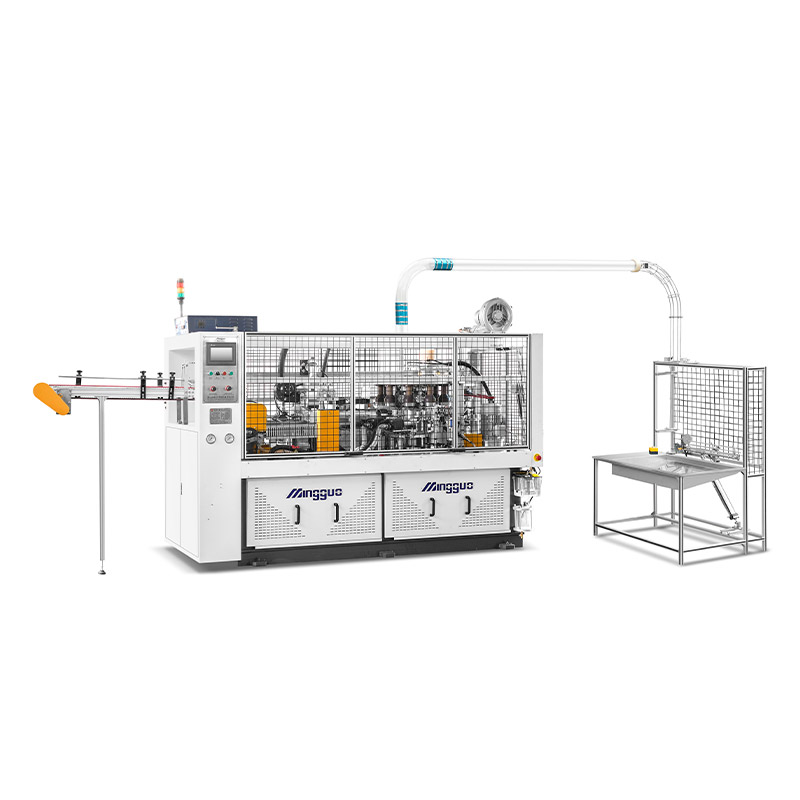
Paper cups specifications:
200 pcs/min
4-16oz(100-450mI) (mold exchangeable)
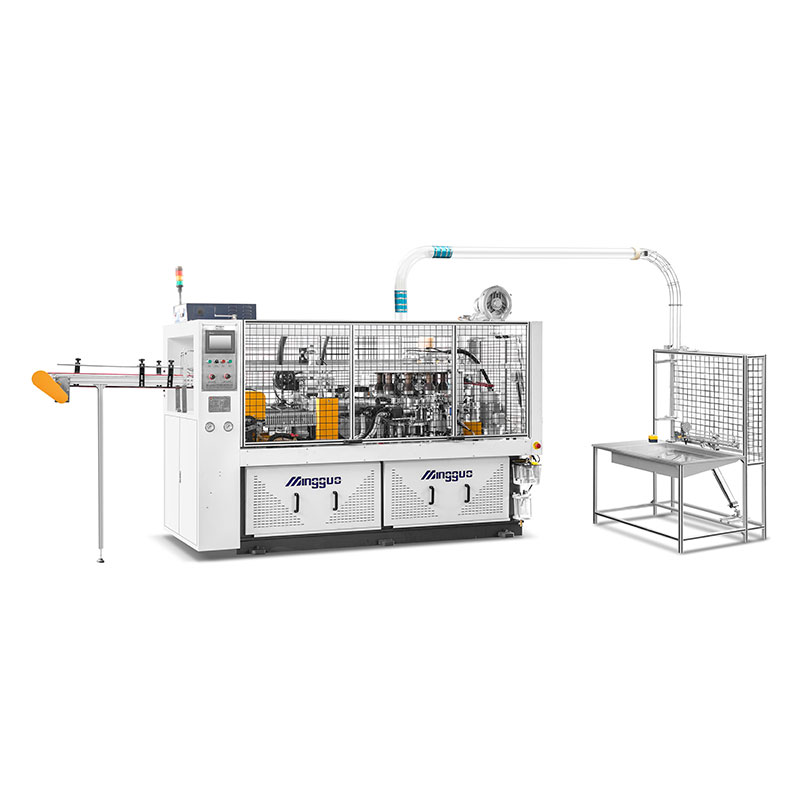
Paper cups specifications:
4-16oz (can be customized by max.26oz)
(100-450ml)(mold exchangeable)
Top:55-105mm
Height:60-135mm
Bottom:55-75mm
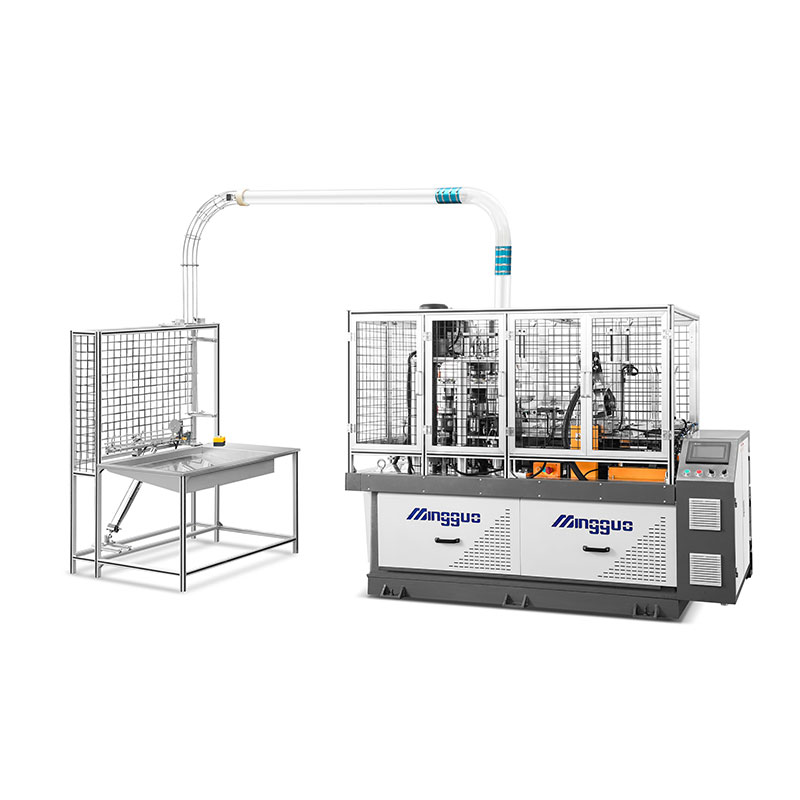
Paper cups specifications:
(100-350ml)(mold exchangeable)
Top: 55-90mm
Height: 60-110mm
Bottom: 40-65mm


